
Menu

What Is the Best Type of Pure Zirconia in 2026?

In 2026, “Pure Zirconia” remains a popular phrase, but it does not identify one single dental material. Many zirconia restorations contain stabilizing ingredients, such as yttria, that influence their strength and appearance. The label alone tells you very little. Small differences matter.

This guide compares the main zirconia options used for crowns and other restorations, including 3Y, 4Y, and 5Y formulations. In general, materials with more yttria can offer greater translucency, while some less translucent formulations are chosen for higher strength. These are useful patterns, not guarantees. Actual performance depends on the product, restoration design, processing, and where the restoration will be placed.

So, what is the best type of Pure Zirconia in 2026? It depends on the clinical need. A highly aesthetic front-tooth crown may call for different trade-offs than a restoration exposed to heavy chewing forces. The dentist’s assessment, the manufacturer’s technical data, and evidence for the specific product all deserve attention. Shade, thickness, fit, and laboratory finishing can also change the final result.

Marketing language can make these distinctions sound simpler than they are. It sometimes does. This article separates common claims from practical selection factors, while noting where evidence or product-specific details matter. No single zirconia type is automatically best for every patient. A careful choice balances appearance, strength, and the demands of the individual case.
What Is the Best Type of Pure Zirconia in 2026?

How Pure Zirconia Is Defined and Classified

“Pure zirconia” sounds like a single, precise material, but the term can be misleading. Chemically, zirconia is zirconium dioxide, or ZrO₂. In practical ceramics, however, completely unstabilized zirconia is uncommon because its crystal structure changes with temperature. These changes can cause cracking during cooling.

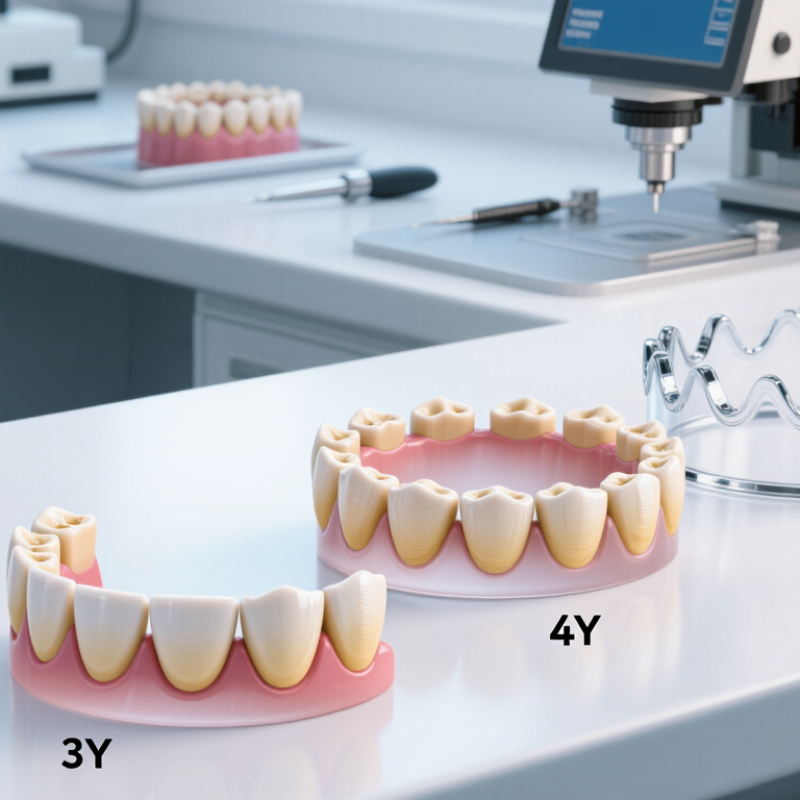
A useful classification looks at composition and crystal phase. Dental zirconia is often grouped by yttria content: 3Y, 4Y, or 5Y, referring to approximate molar percentages. Adding yttria helps retain stable crystal phases at room temperature. In general, 3Y materials tend to offer greater strength, while 4Y and 5Y options often allow more light through. The trade-off is not absolute. Processing and formulation matter, too.

Look closely at the label. A block may also contain small amounts of pigments or other additives, so “pure” does not always mean chemically additive-free. Classification may also describe translucency, intended use, or manufacturing method. For example, a pale, highly translucent disc and an opaque, high-strength blank may both be zirconia, yet behave differently in a restoration. That distinction matters. No single type is best for every case; the right choice depends on the required strength, appearance, and design.

Which Properties Distinguish the Main Pure Zirconia Types

What Is the Best Type of Pure Zirconia in 2026?

Which Properties Distinguish the Main Pure Zirconia Types

In dentistry, “pure zirconia” usually means a zirconia-based ceramic, not unstabilized zirconium oxide. The main types are 3Y, 4Y, and 5Y, named for their approximate yttria content. More yttria stabilizes more cubic crystal structure. That usually improves translucency, but reduces the transformation toughening that helps resist crack growth. A 3Y restoration may look less glass-like under a bright operatory light, yet it is often chosen where strength matters most. 5Y can appear more lifelike, especially in thin anterior crowns, but is less forgiving of heavy loading. It is a trade-off, not a ranking.

Strength figures need context. ISO 6872:2015 sets flexural-strength requirements by ceramic class and intended use; for example, Class 5 requires at least 800 MPa. That threshold is not a guarantee for every 3Y product or finished crown. Specimen shape, polishing, sintering, and test method all affect reported results. A 2018 review by Zhang and Lawn in Materials describes how zirconia’s phase composition influences strength, toughness, and translucency. In practice, compare the technical data for the exact material and indication. A polished, well-supported 4Y crown may serve better than a stronger material with poor fit. These comparisons are imperfect, and the evidence does not make one type best for every case.

How Purity, Stabilization, and Grain Structure Affect Performance

What Is the Best Type of Pure Zirconia in 2026?

“Pure zirconia” does not identify one universally best material. Performance depends on chemical purity, stabilizing additives, and grain structure. High purity can reduce unwanted inclusions, but it cannot guarantee strength or long service life. Stabilizers such as yttria help retain useful crystal phases as temperatures change. The right amount depends on the intended application and operating conditions.

Grain size also matters. Fine, consistent grains can support strength and a smoother surface, while grain boundaries influence wear and crack growth. In dental or technical components, a small processing difference may change translucency, toughness, or resistance to aging. There is a trade-off. It is easy to overvalue a clean specification sheet; real performance also depends on forming, firing, and quality control. Ask for test data relevant to your use, rather than relying on purity alone.

Tips: Match the zirconia grade to its job. Check stabilizer content, grain-size data, and aging or strength tests. If conditions are demanding, get material-specific guidance before choosing.

How to Compare Pure Zirconia Types for Different Applications in 2026

What Is the Best Type of Pure Zirconia in 2026?

“Pure zirconia” usually means a zirconia ceramic without added glass, not chemically pure zirconium oxide. Dental grades are commonly stabilized with yttria. The amount affects strength and translucency, so compare the material’s composition and intended use rather than relying on the label alone.

Three-mol-percent yttria zirconia, often called 3Y, typically offers high strength but a more opaque appearance. It can suit posterior crowns and some bridges exposed to heavy chewing forces. Four-mol-percent, or 4Y, provides a middle ground for cases needing both durability and improved light transmission. Five-mol-percent, or 5Y, is generally more translucent and may work well for anterior restorations where appearance matters. It usually has lower strength than 3Y, so span, thickness, and bite forces deserve careful review.

Details matter. A thin, highly translucent crown may not be the right choice for a patient who grinds their teeth. Check the restoration’s dimensions, design, firing instructions, and clinical indication against current technical data. Also consider the shade of the prepared tooth; it can show through thinner materials. There is no universal winner. I would not choose by translucency alone, and the ideal balance can be less obvious than a product chart suggests.

What Is the Best Type of Pure Zirconia in 2026? — How to Compare Pure Zirconia Types for Different Applications in 2026

Comparison factor 3Y zirconia (3 mol% yttria) 4Y zirconia (4 mol% yttria) 5Y zirconia (5 mol% yttria) Practical selection guidance
Material category Yttria-stabilized zirconia, commonly described as 3Y-TZP. It is predominantly tetragonal zirconia. Yttria-stabilized zirconia with a mixed tetragonal and cubic phase structure. Yttria-stabilized zirconia with a higher cubic-phase content than typical 3Y or 4Y materials. “Pure zirconia” is often used informally. Dental zirconia is generally yttria-stabilized zirconium dioxide, not chemically pure, unstabilized zirconia.
Typical flexural strength Often about 900–1,200 MPa for dental materials, depending on product, specimen preparation, and test method. Often about 600–900 MPa, with substantial variation among formulations and tests. Often about 400–700 MPa; specific materials can fall outside this range. Use the specific material’s technical documentation. Strength figures from different test methods or products are not directly interchangeable.
Relative translucency Lowest of the three types in many conventional formulations. Intermediate; typically more translucent than 3Y while retaining more strength than many 5Y materials. Typically the most translucent of the three, although shade, thickness, and formulation also affect appearance. Choose translucency alongside strength requirements, restoration thickness, shade, and the appearance of the underlying tooth or abutment.
Transformation toughening Generally offers the strongest transformation-toughening contribution of these options. Has less transformation-toughening potential than typical 3Y materials. Has limited transformation toughening compared with 3Y because of its greater cubic-phase content. Higher translucency does not automatically mean better performance in every case; fracture risk and design matter.
Common dental applications High-load posterior crowns, short-span frameworks, and situations where strength is a priority. Monolithic crowns and selected multi-unit restorations where a balance of strength and translucency is desired. Anterior crowns and other esthetic restorations when the required design and manufacturer guidance permit its use. Follow the material’s approved indications, minimum thickness, connector dimensions, and clinical guidance.
Main trade-off Greater strength potential, but often a more opaque appearance. A compromise between strength and translucency; exact performance depends on the formulation. Greater translucency, but generally lower strength than 3Y and many 4Y options. There is no single “best” type for every application. The best choice is the one that meets both esthetic and mechanical requirements.
What to verify before selection Indicated restoration types, strength test standard, minimum thickness, and shade or opacity options. Indications for single-unit or multi-unit use, connector requirements, and tested strength values. Approved use, minimum wall thickness, connector dimensions, and limitations for high-load cases. Check current product documentation and consult the treating dental professional or dental laboratory for case-specific decisions.

Note: Strength and translucency ranges are general descriptions of commonly reported dental zirconia classes, not guaranteed specifications. Actual values vary by composition, processing, specimen geometry, and test method.

Which Pure Zirconia Type Best Fits Each Use Case in 2026

What Is the Best Type of Pure Zirconia in 2026?
Which Pure Zirconia Type Best Fits Each Use Case in 2026?

“Pure zirconia” usually refers to zirconia ceramics stabilized with yttria, not chemically pure zirconium dioxide. For many dental restorations, 3Y zirconia prioritizes strength and suits demanding posterior crowns or bridges. Its lower translucency can make it look less lifelike, especially near the front teeth. 4Y offers a middle ground: more light transmission than 3Y, with useful strength for many single crowns. 5Y is generally more translucent and can suit anterior crowns where appearance matters most. It gives up some strength in return.

The label alone cannot determine the best choice. Framework design, restoration thickness, bonding protocol, and the specific material’s validated indications all matter. A thin 5Y crown may not be the right option for a high-load bite, while opaque 3Y may disappoint when matching a visible front tooth. Material data and clinical guidance should inform the decision. There is no universal winner, and the trade-off is easy to underestimate.

Tips: Match translucency to tooth position and strength needs. Check the manufacturer’s instructions, then confirm the choice with the dentist and dental laboratory. The shade sample helps, but it cannot show the whole result.

What Is the Best Type of Pure Zirconia in 2026?

Which zirconia type best fits each use case?

3Y zirconia is generally preferred for high-load posterior restorations, 5Y for cases where greater translucency is a priority, and 4Y as a balance between strength and esthetics. Strength ranges are indicative; values vary by material, product, and test method. Choose according to restoration design and clinical requirements.