How to Choose API 5L SSAW Carbon Steel Pipe in 2026?
Choosing an API 5L SSAW carbon steel pipe in 2026 requires more than comparing prices and wall thicknesses. Project conditions should guide every decision. Line pressure, operating temperature, soil movement, fluid properties, and installation methods all affect pipe performance. A pipe that suits a water transmission line may fail to meet an oil or gas project’s demands.
Experienced buyers examine the pipe grade, diameter, wall thickness, PSL level, and manufacturing records. They also review chemical composition, tensile strength, impact results, weld quality, and dimensional tolerances. Reliable suppliers should provide traceable mill test certificates and clear inspection reports. Independent inspection can verify markings, ultrasonic testing, hydrostatic testing, and coating condition before shipment. Small details matter. A missing heat number can delay acceptance.
The 2026 market may offer advanced production controls, but technology does not replace careful verification. API 5L requirements should be checked against the latest applicable edition and project specifications. Regional standards, transport conditions, and client approvals may add further requirements. In practice, procurement teams sometimes focus too heavily on initial cost. That approach can overlook welding compatibility, corrosion protection, and long-term maintenance. I have seen apparently minor documentation gaps create expensive delays. That experience deserves reflection. The best API 5L SSAW carbon steel pipe is not simply the cheapest option. It is the pipe with verified quality, suitable performance, dependable traceability, and a supplier willing to answer difficult questions. Inspect closely. Then decide with evidence.
Define the Project Requirements for API 5L SSAW Pipe
How to Choose API 5L SSAW Carbon Steel Pipe in 2026?
Define the Project Requirements for API 5L SSAW Pipe
Start with the service conditions, not the mill quotation. Record the fluid, design pressure, operating temperature, flow rate, burial depth, and installation method. Include corrosion allowance and external loads. A coastal pipeline may need stronger coating protection than an inland line. The decision is rarely just about diameter.
API Specification 5L separates PSL1 and PSL2 requirements. PSL2 usually demands tighter chemical controls, testing, and traceability. Specify the grade, outside diameter, wall thickness, pipe length, and hydrostatic test pressure. For sour or low-temperature service, define impact testing and additional material requirements in the purchase specification. Small omissions become expensive later.
A useful reality check is the World Steel Association’s World Steel in Figures 2024 report. It recorded about 1.89 billion tonnes of crude steel production worldwide in 2023. Supply exists, but suitable pipe availability can still be narrow. Spiral welded pipe needs consistent seam quality, dimensional control, and documented nondestructive testing. Ask for mill test certificates, weld inspection records, coating data, and heat-number traceability. Do not rely on “API compliant” alone. That phrase is too vague. An experienced engineer should review the operating assumptions again; preliminary data is often incomplete.
Match Pipe Dimensions, Wall Thickness, and End Finish
How to Choose API 5L SSAW Carbon Steel Pipe in 2026?
Selecting API 5L SSAW carbon steel pipe starts with the actual line design, not a supplier’s standard size list. Match the outside diameter to flow demand, installation space, and connection details. A 24-inch pipe may suit transmission service, but it can create difficult lifting and alignment problems on a crowded site. Check pipe length, ovality, straightness, and permitted dimensional tolerances against the current project specification. API 5L compliance alone does not guarantee a perfect fit.
Wall thickness needs closer attention. Calculate pressure requirements, corrosion allowance, external loads, and welding conditions together. A thicker wall adds strength, but also increases weight, cost, and field-welding time. For buried lines, soil loading and handling damage matter. For exposed lines, wind, supports, and temperature changes may control the choice. Do not copy an old purchase order blindly. Service conditions may have changed.
End finish affects installation speed. Plain ends work well for field welding, while beveled ends require a controlled bevel angle and clean root area. Threaded ends are usually unsuitable for larger transmission pipes, but smaller connected sections may differ. Confirm bevel dimensions, end squareness, caps, and surface protection before dispatch. Request mill test certificates, dimensional records, weld inspection results, and hydrostatic test evidence. Small details matter. A practical review should also compare actual delivery constraints, because the “correct” pipe can still arrive too long, too heavy, or poorly protected.
How to Choose API 5L SSAW Carbon Steel Pipe in 2026? — Match Pipe Dimensions, Wall Thickness, and End Finish
| Example Outside Diameter | Example Wall Thickness | Possible API 5L Grade | Suggested End Finish | Typical Selection Consideration |
| 406.4 mm (16 in) | 8.0–12.7 mm | Grade B, X42, or X52 | Plain end or beveled end, as specified in the purchase order | Confirm design pressure, loading, corrosion allowance, and connection method before selecting the wall thickness. |
| 508.0 mm (20 in) | 8.0–14.3 mm | Grade B, X42, or X52 | Beveled end for butt welding; plain end where the connection design requires it | Check the required joining procedure and ensure the selected thickness is compatible with the project design. |
| 609.6 mm (24 in) | 9.5–16.0 mm | Grade X42 or X52 | Beveled end is commonly specified for field butt welding | Review pressure, external loads, route conditions, and any project-specific minimum wall requirements. |
| 762.0 mm (30 in) | 10.0–19.1 mm | Grade X42, X52, or X60 | Beveled end or plain end, according to the specified joint design | For larger diameters, confirm handling, installation, weld preparation, and dimensional tolerances in the order specification. |
| 914.4 mm (36 in) | 12.7–20.0 mm | Grade X52 or X60 | Beveled end for welding, with bevel details defined by the applicable specification or purchase order | Verify the required grade, pipe length, inspection level, and project-specific design conditions. |
| 1,016.0 mm (40 in) | 14.3–22.2 mm | Grade X52 or X60 | Beveled end or another agreed end preparation | Confirm that the selected dimensions and manufacturing route are available and acceptable for the project before placing an order. |
These are illustrative dimension and grade combinations, not a substitute for engineering design or a complete API 5L size range. Outside diameter and wall thickness must be stated in the purchase specification; grade, PSL, manufacturing requirements, tolerances, inspection, and end preparation should also be agreed. Select the final wall thickness using the applicable design code and project conditions. Bevel geometry and end-face requirements should follow the ordered specification and approved welding procedure.
Check Manufacturing Quality, Testing, and Traceability
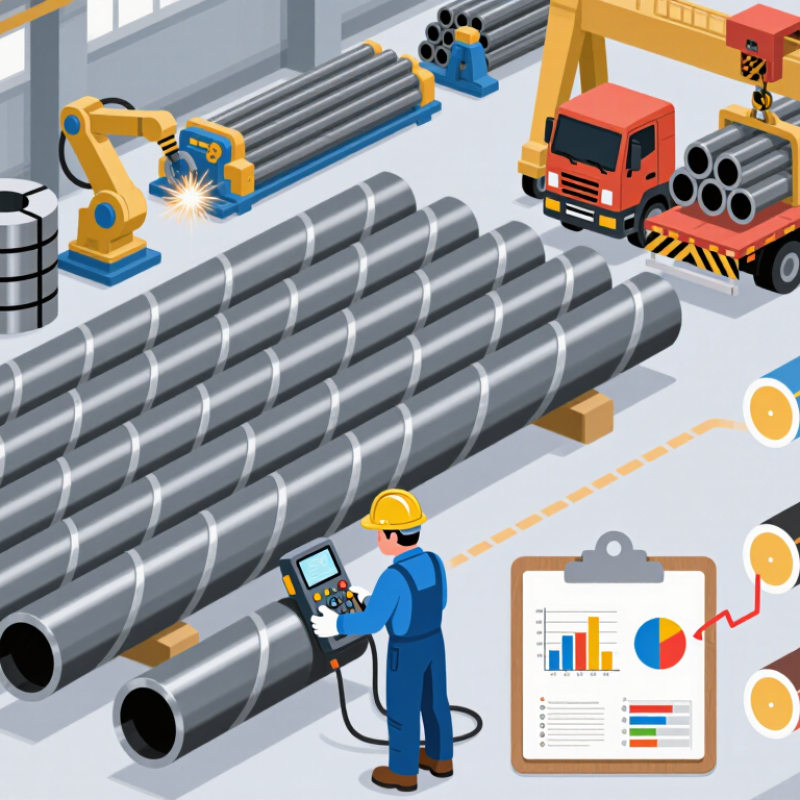
In 2026, choosing an API 5L SSAW carbon steel pipe should begin with factory evidence, not a low quotation. Ask for the manufacturing route, steel grade, diameter, wall thickness, and applicable product specification. During a plant visit, inspect plate storage, edge preparation, spiral forming, welding stations, and heat-number markings. Clean records matter. Photographs help, but they cannot replace witnessed checks.
Quality control should connect each pipe to measurable results. Review chemical analysis, tensile data, bend tests, hydrostatic pressure records, and weld inspection reports. For SSAW pipe, examine ultrasonic or radiographic coverage, acceptance criteria, calibration dates, and inspector qualifications. Confirm that test samples represent the actual production batch. A certificate without matching heat numbers is only paper. Verify the certificate details against the latest contract and inspection requirements.
Traceability is often where procurement becomes practical. Each pipe should carry durable identification linked to the plate heat, coil, weld log, inspection results, and dispatch documents. Check whether markings remain readable after coating, handling, and outdoor storage. Independent inspection can witness sampling and reconcile quantities before shipment. Still, no inspection plan is perfect. I would record open questions instead of forcing a clean approval when evidence is incomplete. That small hesitation may prevent costly disputes at installation.
How to Choose API 5L SSAW Carbon Steel Pipe in 2026?
Compare the specified minimum yield strength of common API 5L grades when assessing pipe requirements.
These are standard minimum yield-strength values for the grades shown, not inspection results or a complete measure of manufacturing quality. Confirm the applicable API 5L edition, PSL, dimensions, testing, and traceability requirements for the project.