
Menu

How to Choose LED Light Panels in 2026?

Choosing Led Light Panels in 2026 requires more than comparing brightness and purchase prices. The International Energy Agency reports that lighting uses roughly 15% of global electricity. That figure makes efficiency a practical purchasing issue, not a decorative detail. The U.S. Department of Energy’s Solid-State Lighting research reports also show continuing progress in LED efficacy, controls, and thermal management. However, laboratory performance may not match a crowded office ceiling.

A reliable selection begins with the room’s actual task. For a design studio, panels should provide accurate color rendering, stable output, and controlled glare. Look for a CRI of 90 or higher when evaluating fabric, artwork, or printed samples. Offices may need low UGR performance, while warehouses often prioritize high lumen output and long operating hours. Check delivered lumens, not only LED chip wattage. A 40-watt panel producing 4,800 lumens gives about 120 lumens per watt before installation losses.

The DesignLights Consortium’s technical requirements and ENERGY STAR guidance provide useful benchmarks for efficiency, flicker, warranty, and tested performance. Verify certification records, driver quality, emergency compatibility, and dimming protocols such as 0–10V or DALI. Ask for LM-79 photometric testing and LM-80 data when available. These documents reveal more than glossy packaging.

Do not ignore the ceiling grid. Measure it first. A panel that fits poorly can create dark borders, visible seams, or unsafe wiring. In 2026, smart controls may reduce energy use further, but compatibility still causes avoidable failures. This is where buyers should remain cautious. The newest feature is not always the best investment. Total cost, service access, light comfort, and honest documentation should guide the final decision.
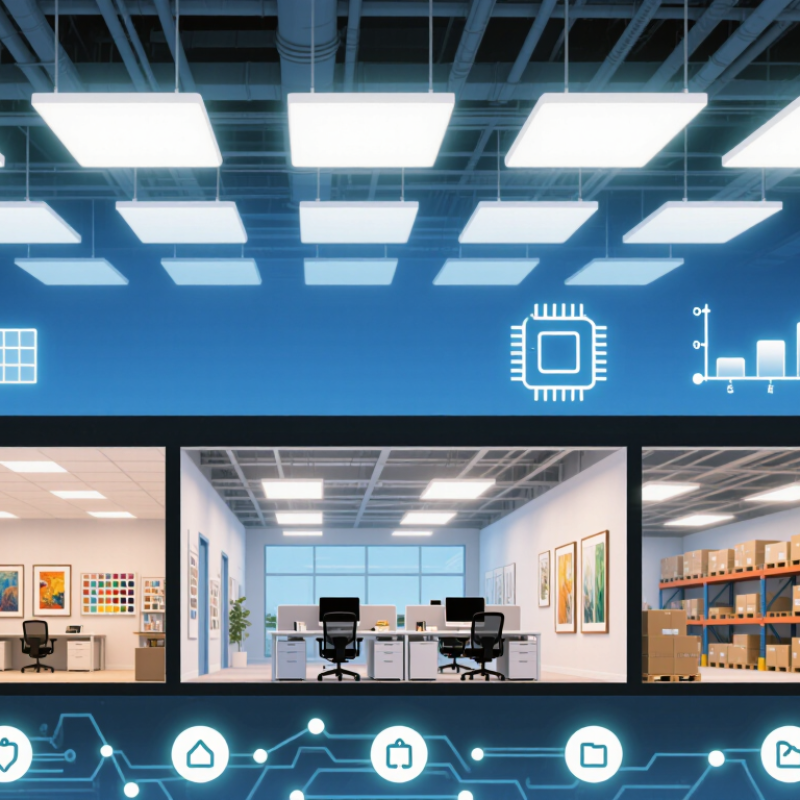
How to Choose LED Light Panels in 2026?

Identify Panel Types and Core Specs: 100–150 lm/W Efficacy, CRI 80+

Choosing LED Light Panels in 2026

LED panels are available in edge-lit, back-lit, suspended, and surface-mounted designs. Edge-lit panels create a slim profile, but their diffuser quality matters greatly. Back-lit panels often provide more even illumination and better thermal control. I have seen inexpensive panels develop dark corners after months of daily operation. That problem is easy to miss in a showroom.

Compare efficacy, not wattage alone. A practical target is 100–150 lumens per watt, measured under usable operating conditions. Some product sheets quote the LED chip’s output instead of the complete panel’s output. Ask for tested system performance. CRI 80+ suits offices, corridors, and general commercial areas. For retail, healthcare, studios, or detailed color work, CRI 90 or higher is usually safer. Skin tones and printed colors can look noticeably different under weak color rendering.

Check UGR, flicker, color temperature, and expected lifetime. A panel with low glare can reduce screen reflections in an office. Selectable 3000K, 4000K, or 5000K settings may simplify future changes. Flicker data should come from credible testing, not vague marketing language. I once focused too heavily on efficacy and overlooked driver replacement access. That decision increased maintenance time. Review the warranty, thermal design, installation method, and actual ceiling conditions before choosing. The brightest panel is not always the most comfortable one.

Match Size, CCT and Glare Control: 3000–6500 K and UGR<19

Choosing LED light panels in 2026 starts with the room, not the product catalogue. In site audits, I often see panels selected by wattage alone. That approach misses ceiling height, desk spacing, and visual comfort. Match the panel size to the grid. A 600 × 600 mm panel suits many modular ceilings, while larger panels can reduce visible seams in open offices. Confirm the actual lumen output, not only wattage.

CCT should follow the task and the occupants. Choose 3000–3500 K for reception areas and hospitality spaces. Use 4000–5000 K for offices, classrooms, and workshops. Reserve 6500 K for specialized applications, because it can feel harsh during long use. The IEA’s Energy Efficiency 2024 report estimates that lighting still represents about 15% of global electricity consumption. Efficient panels matter, but poor color choices can undermine comfort and productivity.

Glare control needs measured evidence. Specify UGR<19 for many office and computer-based environments, then verify the manufacturer’s test conditions. CIE 117 defines the Unified Glare Rating method, but real rooms still change the result. Dark screens, glossy desks, and low ceilings can increase discomfort. I once underestimated reflected glare from a polished table. The drawing looked correct. The room did not. Check beam distribution, shielding angle, luminance, and sample panels under working conditions. A small mock-up is often more reliable than a perfect spreadsheet.

Calculate Required Illuminance: 300–500 Lux for Offices, 500 Lux for Classrooms

Choosing LED light panels in 2026 starts with the room’s actual lighting task, not panel appearance. For offices, target 300–500 lux on the working plane, usually measured about 0.75 metres above the floor. Classrooms generally need 500 lux across desks, although whiteboards may require separate vertical lighting. Use a calibrated lux meter, then measure several desks and corners. One bright reading can mislead.

To estimate output, multiply room area by target lux, then allow for maintenance losses and fixture distribution. A 20-square-metre office at 400 lux needs 8,000 delivered lumens before adjustment. With a 0.8 utilisation factor and 0.8 maintenance factor, the installed requirement rises to about 12,500 lumens. Panel spacing, ceiling height, wall colour, and glare control change the result. Check glare rating, flicker performance, colour rendering, and dimming compatibility. A cool, bright room may still feel tiring. That is where calculations need human judgment. I have seen layouts pass a centre-point test but leave working corners dull. Recheck after installation, especially when furniture or partitions move. Do not assume more lux always means better visibility.

Assess Drivers, Dimming and Flicker: 0–10 V, DALI and IEEE 1789

Choosing LED light panels in 2026 starts with the driver, not the frame. The driver controls efficiency, dimming behavior, thermal stability, and visible flicker. Ask for full-load and minimum-load performance. A panel that dims to 1 percent on paper may jump, glow, or switch off at 5 percent. Test it in the actual ceiling circuit. That matters.

0–10 V control is simple and widely understood, but it needs correct polarity, cable routing, and driver compatibility. At the wall, verify smooth transitions from full output to minimum output. DALI provides digital addressing, scenes, feedback, and detailed configuration. However, commissioning requires more knowledge. A poorly configured group can create uneven brightness. Keep control-system and driver specifications together.

Flicker requires more than a phone-camera check. Ask for modulation depth, frequency, and test conditions. Compare the results with IEEE 1789 recommendations. This standard offers guidance, not a universal pass label. I prefer measurements at several dimming levels, especially below 10 percent. A quiet office may reveal ripple through moving shadows or camera banding. My judgment is not flawless. Wiring, settings, and temperature can change results. Independent measurements remain valuable.

Verify Lifetime, Safety and Value: L70 50,000+ Hours, CE and RoHS

How to Choose LED Light Panels in 2026?

A reliable LED panel begins with verified lifetime, not a large number on the box. L70 50,000+ hours means the panel should retain at least 70% of its initial light output after that period. Ask for LM-80 test data and a TM-21 projection, rather than accepting an unsupported estimate. The U.S. Department of Energy’s Solid-State Lighting R&D Opportunities report identifies efficacy, quality, and reliability as continuing industry priorities. The International Energy Agency reports that lighting uses roughly 15% of global electricity. Better panels can reduce energy waste, but poor thermal design can shorten their useful life. That detail is easy to miss.

Safety documents matter just as much. CE indicates conformity with applicable European requirements, while RoHS addresses restricted hazardous substances. Neither mark alone proves brightness, lifetime, or flicker performance. Check the declaration of conformity, test laboratory details, operating temperature, surge protection, and driver specifications. In real installations, a hot ceiling void can expose weak components quickly. A panel may pass paperwork and still disappoint. This is where buyers should remain skeptical.

Tips: Compare maintained lumens, not initial lumens. Request the full LM-80 and TM-21 files. Check whether 50,000 hours assumes a controlled temperature. Review flicker results, insulation ratings, and emergency compatibility. Also compare warranty terms with operating hours. A cheaper panel can become expensive after repeated replacement, although efficiency figures are sometimes overstated.