What Is Artificial Marble and How Is It Made?
Artificial Marble is an engineered surface designed to bring the look of natural stone into kitchens, bathrooms, and commercial spaces. It is commonly made from mineral particles, pigments, and a resin binder, then shaped and cured into slabs. The exact recipe varies by manufacturer. That variation matters: it affects color, surface texture, strength, and care requirements.
A useful way to understand the process is through materials scientist Dr. George W. Scherer’s work on how composition and processing influence material behavior. This is a paraphrase of that principle, not a direct quotation: the ingredients and the way they are processed help determine how a finished material performs. In artificial marble production, manufacturers blend mineral fillers with resin and pigments, cast the mixture into a mold, and cure it under controlled conditions. Some products are then polished to create a smooth, glossy finish. Small differences in pigment distribution can change the slab’s appearance.
The result can offer consistent patterns and a broad range of colors. Still, it is not identical to natural marble. Resin-based surfaces may respond differently to heat, scratches, or harsh cleaners, so product specifications deserve a close read. A sample helps. It reveals the real color, gloss, and texture under your lighting. In the sections ahead, we’ll examine what Artificial Marble contains, how it is made, and what to consider before choosing it.
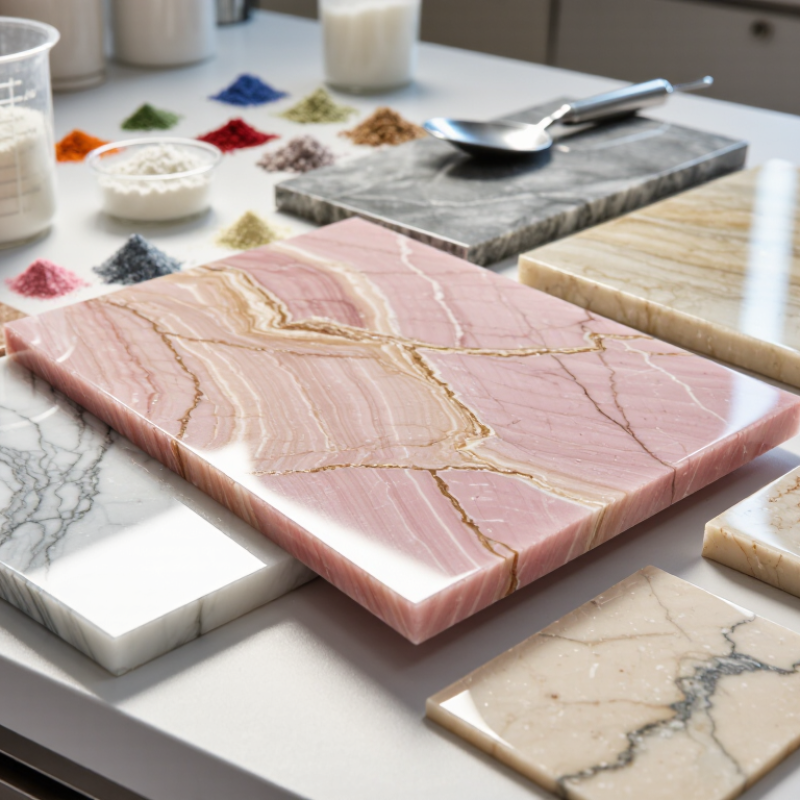
What Artificial Marble Is and How It Differs from Natural Stone
Artificial marble is a manufactured surface, not a slab cut from a geological formation. It usually combines marble chips or calcium-carbonate powder with resin and pigments, then cures in a mould. The mixture can create consistent colours and repeatable patterns. Natural marble forms when carbonate rock changes under heat and pressure, so its veins and mineral variations develop over time. Each slab is different.
The distinction affects more than appearance. Resin-bound surfaces may be less porous, but heat, sunlight, and harsh cleaners can affect some formulations. Natural marble can stain or etch, yet its mineral structure is not held together by polymer resin. OSHA and NIOSH report that engineered stone may contain over 90% crystalline silica; this figure mainly describes silica-rich engineered stone, not every artificial-marble product. Check the product’s technical sheet rather than assuming all composites share that composition. That distinction matters. The label “artificial marble” is also imperfect: recipes vary, and some products use other binders or fillers. Two surfaces that look similar may need different care.
Materials Used to Make Artificial Marble
Artificial marble is usually a cast-polymer composite, not a solid block of natural stone. Its mineral filler may include marble dust, limestone, or calcium carbonate; some products use alumina trihydrate. Polyester or acrylic resin binds the particles, while pigments create veining and color. The USGS Mineral Commodity Summaries 2024 estimates that the United States produced about 1.5 billion tons of crushed stone in 2023. That figure shows the scale of mineral supply, not the amount used in artificial marble.
In manufacturing, the filler and resin are blended, poured into a mold, and cured. Vacuum mixing can reduce trapped air, which otherwise leaves pinholes or weak spots. A thin gel-coat layer often gives the finished surface its smooth sheen. The exact recipe varies by product and intended use; a bathroom vanity top may prioritize a clean finish, while a panel may need different strength or thickness. Not all slabs are alike. Resin content, particle size, and curing conditions affect appearance and performance, so a polished sample alone may not reveal the full story.
Tips: Ask for the product’s technical sheet. Check its filler and resin type, stain-care guidance, and heat limitations. Small details matter. A sample can help, but it may not show every vein or color shift in a larger slab.
How Artificial Marble Is Manufactured Step by Step
Artificial marble is a manufactured surface designed to resemble natural stone. Its appearance and performance depend on the mineral filler, resin, pigments, and production controls. Recipes vary. Some products use fine calcium carbonate; others include harder mineral particles. The finished material is not quarried marble, and its pattern is usually created during production.
Manufacturing starts with selecting and grading the mineral filler. Workers blend it with resin, pigments, and measured additives until the mixture is even. The mixture is placed in a mold, then compacted—often with vibration and vacuum—to reduce trapped air. Next, it cures under controlled conditions. Exact temperatures and curing times depend on the formulation. After curing, the slab is removed, trimmed, and calibrated to an even thickness. Its face is ground and polished, then inspected for visible defects and consistency. Small variations can remain; a perfectly uniform pattern is not guaranteed.
Tips: Ask how the surface handles heat, stains, and cleaning before choosing it. Check a full-size sample if possible, since small samples may hide pattern variation. During cutting or grinding, use suitable dust controls and follow the fabricator’s safety guidance.
How Artificial Marble Is Finished and Quality-Checked
After curing, artificial marble slabs are ground with progressively finer abrasives, then polished or given a specified matte finish. Water cools the surface and carries away slurry. Operators watch for pinholes, resin drag, and uneven color, especially near edges and sink cutouts. Small flaws matter. A glossy face can hide shallow waviness until light crosses it at an angle.
Quality checks combine touch, sight, and measurement. A straightedge helps reveal bowing; raking light exposes scratches and dull patches. Gloss should be measured, not guessed: ISO 2813:2014 defines 20°, 60°, and 85° measurement geometries, selected according to surface gloss. EN 14617-1:2005 gives test methods for apparent density and water absorption in agglomerated stone. Those results can flag inconsistent compaction, but cannot prove a slab is flawless. Each batch should also be checked for color consistency, edge chips, and dimensions against its order specification. Resin-rich areas may polish differently. That is easy to miss. A final wipe, followed by inspection under neutral lighting, catches residue that can masquerade as a surface defect.
Common Types and Uses of Artificial Marble
Artificial marble is made by combining mineral particles or powders with a binder, then casting or pressing the mixture into slabs and finished shapes. The exact recipe varies. Some products use marble chips with resin; others use mineral powder, pigments, and cement. Polishing creates a smooth face, while molds can produce integrated sinks or curved edges.
Common types include resin-based cultured marble, marble-chip composites, and cement-bound, terrazzo-like surfaces. Cultured marble is often used for bathroom vanities, shower walls, and bathtub surrounds because it can be formed with fewer seams. Marble-chip composites suit countertops and wall panels, where visible stone flecks add texture. Cement-based versions appear in flooring, steps, and decorative surfaces. Labels can be confusing. Check the stated material, not just the product name.
In daily use, artificial marble offers consistent color and can be easier to shape than natural stone. A pale vanity top may wipe clean with a soft cloth, for example. But resin surfaces can scratch or discolor under high heat, and cement-based products may need sealing. The finish matters, too. I would not assume every type needs the same cleaner; follow the maker’s care instructions and test unfamiliar products in a discreet spot.