In 2026, building hardware is not merely a finishing touch. Hinges, locks, closers, exit devices, and access controls shape how a building works every day. They affect security, accessibility, durability, and the feel of a door in a person’s hand. Small parts. Visible consequences.
Grand View Research’s Door Hardware Market report estimates the global market at about $17 billion in 2023 and projects continued growth through 2030. That estimate signals strong demand, but it does not tell buyers which product will suit a specific project. A coastal apartment entry, a busy school corridor, and a glass office partition place very different demands on their hardware. Material, traffic, maintenance, and compatibility matter as much as appearance.
Industrial designer Charles Eames captured the importance of detail: “The details are not the details. They make the design.” His observation is not a door-hardware specification, but it fits the subject. A closer that slams, a lever that feels loose, or a lock that conflicts with an access system can undermine an otherwise polished space. This guide compares the leading building hardware types to watch in 2026, including conventional and smart options. It also considers where durability and convenience can compete. One caution: product labels rarely reveal how hardware performs after years of daily use. The specification still deserves a second look.
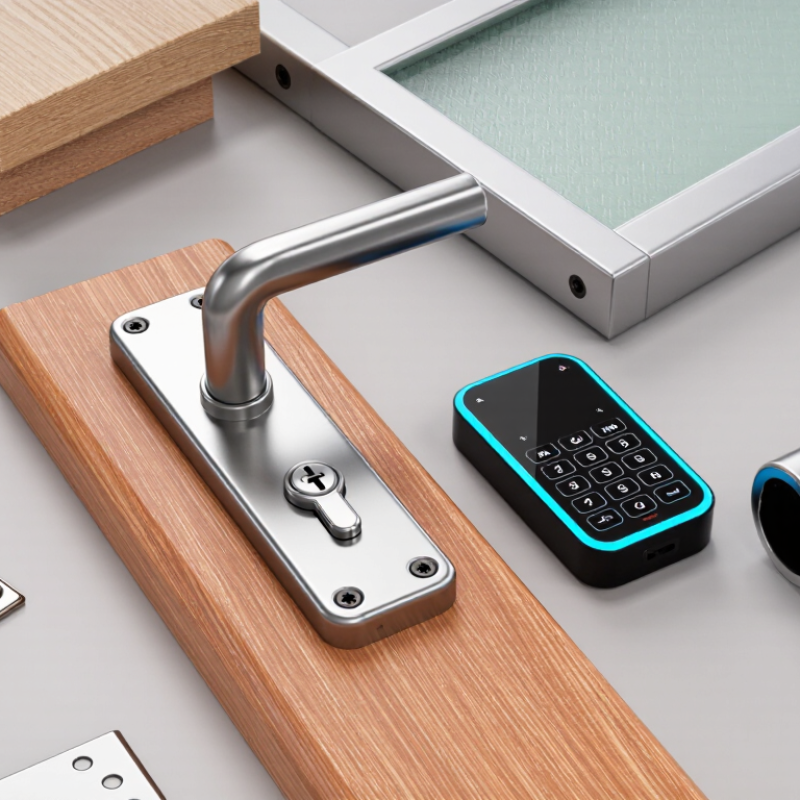
ANSI/BHMA A156.2 provides a practical way to compare bored and preassembled locks and latches. Its cycle ratings describe endurance testing, not a guaranteed lifespan in every building. Grade 1 is tested to 800,000 cycles, Grade 2 to 400,000, and Grade 3 to 200,000. That distinction matters.
A busy school entrance may see repeated daily use, while a storage-room lock may turn only a few times each day. A higher grade can suit demanding doors, but it should not be selected by cycle count alone. Door weight, alignment, installation quality, and maintenance also affect performance. Real doors vary.
When evaluating hardware, match the grade to the door’s use and the cost of failure. A facility team can record trouble such as a loose lever, a latch that misses the strike, or a key that turns roughly. These observations help reveal wear before a lock stops working. Cycle figures are useful benchmarks, but they can tempt buyers to expect a precise replacement date. They do not provide one. Check the full product documentation and applicable test details before comparing ratings.

What Are the Top Building Hardware Types in 2026?
Hinges, closers, and exit devices solve different problems at a doorway. Hinges carry the door’s weight and set its swing. ANSI/BHMA A156.1 covers hinges, while A156.4 covers door closers and A156.3 covers exit devices. These standards provide performance and test requirements; they are not interchangeable ratings. A heavy corridor door may need robust hinges, a closer that controls its return, and an exit device suited to the opening’s use. Small parts matter.
The U.S. Access Board’s 2010 ADA Standards offer useful operating benchmarks: interior hinged doors generally require no more than 5 pounds of opening force, and a closer must take at least five seconds to move from 90 degrees open to 12 degrees. Fire doors have a separate force exception. These figures help teams assess usability, but installation and adjustment affect real performance. A closer can meet a test and still feel too forceful to someone carrying a box. That deserves a second look. Exit devices support quick, straightforward egress; hinges and closers must not undermine that action. Check the applicable A156 requirements, door conditions, and access criteria together, rather than choosing hardware by product category alone.
A functional comparison of hinges, closers, and exit devices. Bar values show the A156 standard number only—not a performance score.
How to read this chart: Hinges support and allow a door to pivot (A156.1); closers control a door’s closing action (A156.4); exit devices provide a means of egress from the door’s egress side (A156.3). The standards are product-specific, so their numbers do not indicate relative quality or performance.
Fire-door hardware is more than a collection of hinges and handles. It helps a rated door close and latch so the assembly can perform as intended during a fire. NFPA 80 requires fire-door assemblies to be inspected and tested at least annually by a qualified person. The inspection should be documented, including deficiencies and repairs. Requirements can depend on the adopted edition and local authority, so confirm which rules apply to the building.
Inspect hinges, latches, closers, coordinators, and any listed hold-open devices. Check that the door swings freely, closes fully, and latches without being pushed by hand. Look for missing fasteners, damaged labels, loose hardware, and gaps that appear uneven. A door propped open with a wedge is a clear concern. Small details matter. A checklist helps, but it cannot replace careful observation; even experienced teams can overlook a dragging edge or a closer that works only intermittently.
Tips: Test each door from a fully open position, then watch it close and latch. Record the location, observed issue, and corrective action. Do not adjust or replace components casually: hardware must remain suitable for the specific fire-door assembly. When a condition is unclear, ask a qualified fire-door professional to assess it before returning the door to service.
In 2026, compare hardware by the load it carries and the environment it faces—not by appearance alone. Window operators and hinges must support the sash, including its glass; a 45-kilogram sash needs a compatible load rating across the complete hardware set. The AAMA/WDMA/CSA 101/I.S.2/A440 window standard evaluates air leakage, water penetration, and structural performance. Those results describe the window assembly, not a guarantee that every hinge or operator can carry any sash. Check both.
Cabinet hinges and drawer slides face repeated opening, concentrated loads, and occasional spills. ANSI/BHMA A156.9 covers cabinet hardware performance, so look for tested cycle and load information rather than relying on a “heavy-duty” label. Sliding-door rollers and tracks carry the door’s full weight; uneven floors or a misaligned track can add friction and accelerate wear. A rating for one component may not validate the whole system. Easy to miss.
Corrosion class matters near coastal air, pool rooms, and damp kitchens. ISO 9227 specifies salt-spray testing, while ASTM B117 describes controlled salt-fog exposure; neither provides a dependable conversion from test hours to years of service. That limitation matters. Compare the stated test method, coating or material, and intended exposure, then inspect edges and fasteners—not just visible surfaces. A neat rating table can still oversimplify real use.
| Application | Hardware type | Typical load or capacity guide | Indicative corrosion environment | Common materials and finishes | Selection considerations |
|---|---|---|---|---|---|
| Window | Friction stays | Many residential systems are specified for sash weights of approximately 20–40 kg per sash; heavier-duty options are available. | C2–C3 indoors or in sheltered locations; C4 may be appropriate for exposed sites when the product is specifically tested for that environment. | Stainless steel, coated steel, or zinc-plated steel, depending on exposure and product specification. | Check the complete stay set’s rated sash mass, sash dimensions, opening angle, and installation requirements. Do not treat the load as a rating for one individual stay. |
| Window | Butt or projecting hinges | Capacity is system-dependent; residential hinge sets are commonly selected for sash weights from roughly 30–80 kg. | C2–C3 for typical sheltered use; C4–C5 exposure calls for a verified corrosion-resistant hinge and compatible fixings. | Stainless steel, aluminium, or coated steel. | Confirm the rated capacity for the specified number of hinges, sash geometry, and fixing substrate. Account for wind loading and frequent operation. |
| Window | Multipoint locking hardware | Usually selected by window profile, locking-point layout, and operating requirements rather than a simple supported-load figure. | C2–C3 for sheltered installations; more resistant finishes and materials are advisable in C4 or higher exposure. | Steel or stainless-steel locking components, often with protective coatings; handles may use aluminium or stainless steel. | Check compatibility with the window profile, locking points, keeps, and weather seals. Corrosion resistance should cover the full assembly, not only the visible handle. |
| Cabinet | Concealed cabinet hinges | For many residential doors, a two-hinge set is used on doors around 5–10 kg; door height, width, thickness, and hinge count affect suitability. | C1–C2 in dry interiors; C2–C3 is a useful target for kitchens, bathrooms, and other areas with greater humidity. | Nickel-plated steel, stainless steel, or coated steel. | Use the hinge maker’s door-size and hinge-count guidance. Heavy, tall, or wide doors may need additional hinges or a higher-rated hinge system. |
| Cabinet | Drawer slides | Common residential full-extension slides are often rated around 25–45 kg per pair; heavy-duty models may carry substantially more. | C1–C2 for dry rooms; choose a suitable corrosion-resistant finish for kitchens, bathrooms, utility rooms, or coastal locations. | Zinc-plated or coated steel; stainless steel options are available for higher-corrosion environments. | Check whether the rating is for a pair, the required slide length, extension type, and mounting orientation. Dynamic use and installation accuracy affect performance. |
| Sliding door | Roller assemblies | Residential interior systems commonly cover approximately 40–100 kg per door leaf, depending on the roller and track system. | C1–C2 for dry indoor use; C3–C4 may be needed for humid or exposed installations when supported by product test data. | Steel or stainless-steel rollers with polymer wheels; materials vary by door and track design. | Match the rollers to the track profile and door mass. Confirm whether the stated capacity applies per roller, per pair, or per complete door set. |
| Sliding door | Track and guide system | Many residential systems are offered for door leaves in the approximate 80–150 kg range; some systems have lower or higher limits. | C1–C2 for interior use; C3–C4 exposure requires a suitably protected track, fixings, and guides. | Aluminium or steel track; stainless-steel or coated-steel fixings and guides. | Verify the complete system rating, track support spacing, fixing substrate, door thickness, and anti-jump or retention features. |
| Sliding door | Soft-close damper | The damper controls closing motion; it does not replace the load rating of the rollers or track. Check its permitted door-mass range. | Usually matched to the same indoor or exposed environment as the associated sliding-door hardware. | Metal housing with engineered polymer or metal damping components. | Confirm compatibility with the door mass, travel direction, track system, and required closing speed. |
How to read the corrosion guidance: C1–C5 are atmospheric corrosivity categories used in ISO 9223; they describe environments, not a universal hardware product grade. The load ranges above are indicative selection guides, not standardized ratings. Confirm the manufacturer’s tested capacity, corrosion test method, installation details, and warranty for the specific product and project conditions.
For accessible routes, the ADA Standards limit opening force to 5 lbf, about 22 newtons, for non-fire interior hinged doors. Fire doors are treated differently and may have separate code requirements. The limit concerns opening the door; force needed to retract a latch is excluded. That distinction matters: a stiff lever can feel like a heavy door, even when the hinge movement itself is manageable.
Check the complete opening, not just the hardware on a workbench. A calibrated force gauge at the handle can help identify resistance from a closer, tight hinges, weather seals, or a misaligned latch. Record the test conditions, since measurement technique and door position affect results. One imperfect shortcut is judging by feel alone. People vary, and a door that seems easy to one person may be difficult for another. Also check closer timing: an ADA-compliant closer should take at least five seconds to move from 90 degrees open to 12 degrees. Timing and opening force are separate checks. A door may close slowly yet still exceed the 5-lbf limit. When readings are high, adjust or repair the cause, then measure again.